

Find your credentials

You need two values from your Adaptive deployment:
CredentialDescription
ADAPTIVE_URLYour deployment URL
ADAPTIVE_API_KEYYour personal API key
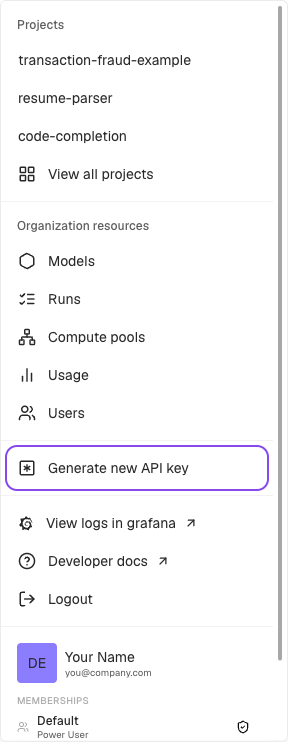
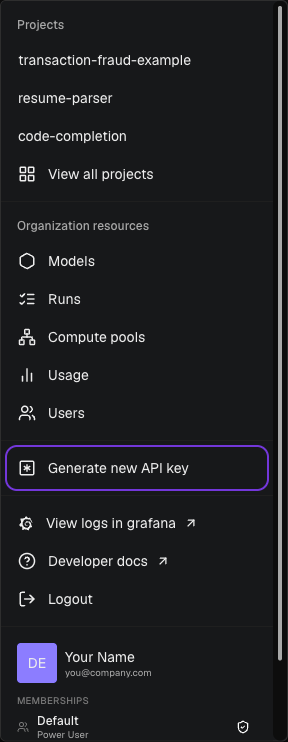
Click the navigation switcher in the top left corner (labeled View all projects) and select Generate new API key. Your deployment URL is provided by your administrator.

Set environment variables

export ADAPTIVE_URL="https://your-deployment.adaptive-ml.com"
export ADAPTIVE_API_KEY="your-api-key"
The SDK and HTTP clients use these environment variables to connect to Adaptive.

Service accounts

Create service accounts for CI/CD pipelines, automation, and programmatic integrations that don’t belong to a human user.
result = adaptive.users.create_service_account(
    name="ci-bot",
    teams_with_role=[("engineering", "power_user")]
)
# result.api_key is returned once; store it securely
The API key is returned once at creation and cannot be retrieved later. Store it immediately. Authenticate the same way as personal accounts: set ADAPTIVE_API_KEY to the returned key. Service accounts follow the same role and team permission model as regular users.
Use the OpenAI Python library with your Adaptive deployment:
import os
from openai import OpenAI

client = OpenAI(
    base_url=f"{os.environ['ADAPTIVE_URL']}/api/v1",
    api_key=os.environ["ADAPTIVE_API_KEY"],
)

response = client.chat.completions.create(
    model="project_key/model_key",
    messages=[{"role": "user", "content": "Hello!"}],
)
Set model to project_key/model_key.
Include your API key in the Authorization header:
Authorization: Bearer ADAPTIVE_API_KEY
curl "$ADAPTIVE_URL/api/v1/chat/completions" \
  -X POST \
  -H "Content-Type: application/json" \
  -H "Authorization: Bearer $ADAPTIVE_API_KEY" \
  -d '{
    "model": "project_key/model_key",
    "messages": [{"role": "user", "content": "Hello!"}]
  }'