> ## Documentation Index
> Fetch the complete documentation index at: https://docs.adaptive-ml.com/llms.txt
> Use this file to discover all available pages before exploring further.
# Architecture
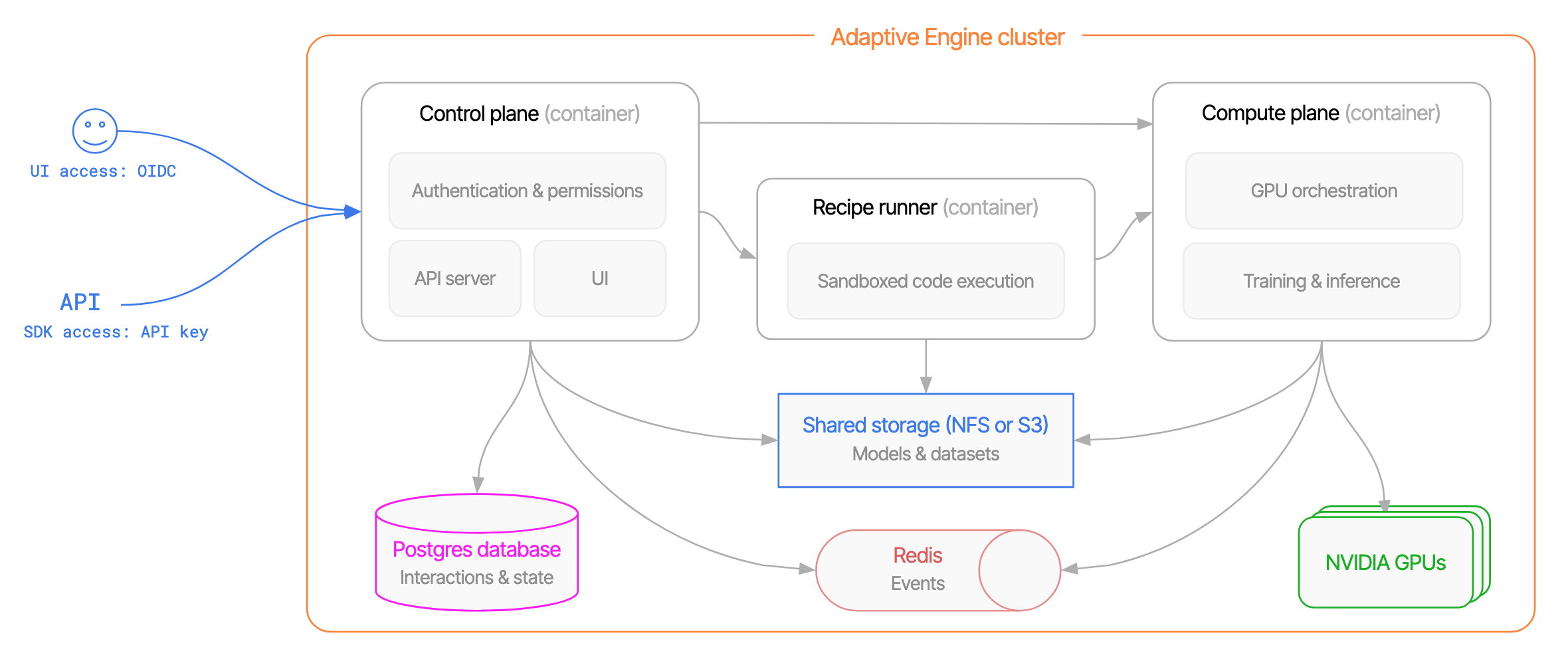
> Adaptive Engine system architecture
An Adaptive Engine cluster consists of 5 components:
1. **Control plane** - UI, permissions system, user-facing APIs
2. **Compute plane** - GPU servers for inference and training
3. **Shared storage** - Model files and training artifacts
4. **Postgres database** - Interactions, metadata, application state
5. **Redis** - Job events and usage statistics
 ## Components
### Control plane
Low-latency containerized service serving the UI and APIs. Runs on CPU (minimum 4 vCPU, 16GB memory).
### Compute plane
Multi-GPU AI computing framework for training and inference.
**Compatible GPUs:** L4, L40, L40S, H100, H200, B200, GB200
**Requirements:**
* Multi-GPU or single-GPU servers supported
* NVLink/NVSwitch optional but recommended for training and large models
* PCIe-connected multi-GPU servers supported (e.g., EC2 g6.12xlarge)
* 300GB+ local storage recommended for Docker images and model cache
Adaptive Engine 0.11 and above do not support NVIDIA A100.
### Shared storage
Model files and datasets. Any POSIX-compatible storage (local disk, NFS) or S3-compatible object storage.
### Database
PostgreSQL 16+. Stores interactions, permissions, and settings. Must be located near the control plane since blocking permission checks run on every inference call.
### Redis
Transfers events between compute and control planes, stores usage statistics and real-time metadata. Can be local or managed (Elasticache, Memorystore, etc.).
### Cloud service examples
| Component | AWS | GCP | Azure |
| ----------------- | ---------------------- | ------------------ | ----------------------------- |
| Control & compute | EC2, EKS | GCE, GKE | Azure VM, AKS |
| Storage | S3, FSx for Lustre | GCS, Filestore | Azure Files NFS |
| Database | RDS PostgreSQL, Aurora | Cloud SQL, AlloyDB | Azure Database for PostgreSQL |
| Redis | Elasticache | Memorystore | Azure Managed Redis |
## Compute plane
## Components
### Control plane
Low-latency containerized service serving the UI and APIs. Runs on CPU (minimum 4 vCPU, 16GB memory).
### Compute plane
Multi-GPU AI computing framework for training and inference.
**Compatible GPUs:** L4, L40, L40S, H100, H200, B200, GB200
**Requirements:**
* Multi-GPU or single-GPU servers supported
* NVLink/NVSwitch optional but recommended for training and large models
* PCIe-connected multi-GPU servers supported (e.g., EC2 g6.12xlarge)
* 300GB+ local storage recommended for Docker images and model cache
Adaptive Engine 0.11 and above do not support NVIDIA A100.
### Shared storage
Model files and datasets. Any POSIX-compatible storage (local disk, NFS) or S3-compatible object storage.
### Database
PostgreSQL 16+. Stores interactions, permissions, and settings. Must be located near the control plane since blocking permission checks run on every inference call.
### Redis
Transfers events between compute and control planes, stores usage statistics and real-time metadata. Can be local or managed (Elasticache, Memorystore, etc.).
### Cloud service examples
| Component | AWS | GCP | Azure |
| ----------------- | ---------------------- | ------------------ | ----------------------------- |
| Control & compute | EC2, EKS | GCE, GKE | Azure VM, AKS |
| Storage | S3, FSx for Lustre | GCS, Filestore | Azure Files NFS |
| Database | RDS PostgreSQL, Aurora | Cloud SQL, AlloyDB | Azure Database for PostgreSQL |
| Redis | Elasticache | Memorystore | Azure Managed Redis |
## Compute plane
 ### Compute pools
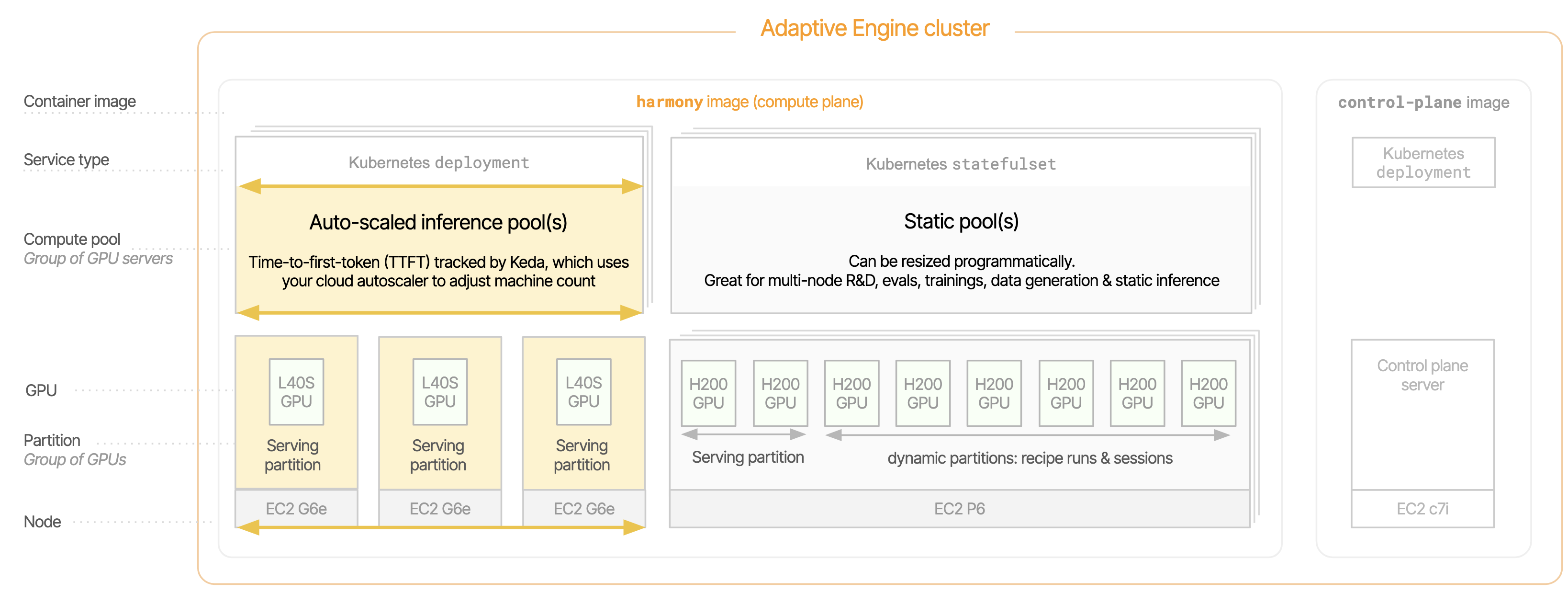
A compute pool is a set of homogeneous GPU servers that receives workloads.
A cluster can have multiple compute pools representing different GPU types or capacity reservations.
### GPU workloads
1. **Inference endpoints** - Low-latency, high-throughput model serving
2. **Recipe runs** - Scripted batch tasks (training, fine-tuning, evaluation)
3. **Interactive sessions** - Real-time remote execution via Secure WebSockets
**Pool targeting:**
* Inference endpoints can span multiple inference or static pools
* Recipe runs and sessions can only be on one compute pool
## Deployment notes
* Built on open standards (Linux, Postgres, Rust, Docker) for portability
* All 5 components can be collocated on a single server
* For production, we recommend to use an external database and storage for independent scaling and availability
### Compute pools
A compute pool is a set of homogeneous GPU servers that receives workloads.
A cluster can have multiple compute pools representing different GPU types or capacity reservations.
### GPU workloads
1. **Inference endpoints** - Low-latency, high-throughput model serving
2. **Recipe runs** - Scripted batch tasks (training, fine-tuning, evaluation)
3. **Interactive sessions** - Real-time remote execution via Secure WebSockets
**Pool targeting:**
* Inference endpoints can span multiple inference or static pools
* Recipe runs and sessions can only be on one compute pool
## Deployment notes
* Built on open standards (Linux, Postgres, Rust, Docker) for portability
* All 5 components can be collocated on a single server
* For production, we recommend to use an external database and storage for independent scaling and availability